Taking time to work...

Taking time to work
Growing up on Holcomb Bridge Road seemed to be boring at the time, but now when I recall the past, I had some fun times. However there was always work to be done.
From the very beginning of my ability to remember there was stuff that had to be done every day without fail. That was what life was like at our home. I remember walking down to collect eggs from the two chicken houses we had. I went with Plessey, who lived in one of the rental houses we had. I think her last name was Massey, but I was really young and somehow don’t remember much about her other than we went and gathered eggs on many occasions. Dad had this gadget called a candler to check to see if the eggs were going to develop into chicks. Yes, we had a rooster that was the big daddy and was he mean. I remember one day, I thought it would be fun to open the gate to the breeding pen and go inside. This was a fairly large fenced in area that dad would place a few hens so that the rooster and the hens could have a honey moon. Well, I was really young but knew I had to latch the gate back or the hens would escape. So I managed to unlatch the gate, walk in and latch it back. As I turned to take a step, here the rooster came. Running faster and faster until he was airborne and taking aim for my face with feet aimed right at my eyes, he was closing in at a frantic pace. I instinctively through up my hands palms covering my eyes and felt his talon slice into the back of my right hand and then he withdrew. I unlatched the gate and latched it back in one motion. Crying and yelling for help, I went running for safety. When ever you see me next, remind me and I can show you that scar as faint as it is, it is a constant reminder of what a jealous rooster can do.
As I grew older and was able to help dad more and more, I had more chores to do around the house. One chore that was kind of fun but was drudgery also was taking the trash out weekly to the burn pile. The drudgery was that it was a long walk out to the burn pile, but the fun was finding some kind of aerosol can in the trash and placing it correctly to allow it to heat and explode early in the timeline of the trash burning. The timing was critical so that the most ashes would be blown skyward, thus providing the most visually satisfying display. The best can was hair spray as sometimes these would not explode but take off like a rocket, propelled by the left over highly ignitable fuel or hair spray and making the most neat sound effects.
Every season of the year had different projects and or chores to perform. Winter time was the most critical for that is the time of the year the cows needed me to feed them every day. I would come home from school and immediately change into my work clothes and galoshes and head down to the barn. The barn was really awesome. It had an attic that in the very early years of my memory, would house the loose hay that was thrown up in there from the hay trailer. We would be able to toss the loose hay down to the feeding troughs from the attic with pitch forks, when we had one milk cow and nothing more. This now reminds me of the first time I ever had store bought milk. Dad was getting tired of having to milk the cow before he went to work and after he got home. So we switched over to store bought milk and I did not like it. The store bought milk tasted weak and was thin as water. The real milk was rich and creamy and had texture. I adapted but still remember the switchover and how the difference resonated with me.
Back to feeding the cows, so the older I got the more cows we had and the more hay we had to put up. Hay time came every summer in the hottest time of the year.
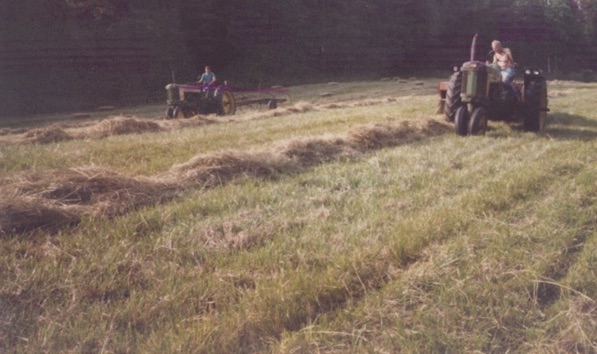
I can remember every summer we hayed our fields. This picture shows dad, topless, on the right and yours truly on the left. We were using “newer” tractors by this time. Dad was on the big boy, Model 530 John Deere and I was raking with the Model 520 John Deere. This photo was taken around 1970.
I remember the first time I ever drove the John Deere B model by myself. I was about 10 years old and dad and I took turns walking along side the hay wagon and picking up hay bales and throwing them onto to the wagon while the other drove the tractor. I was the proudest kid in Newtown Community that day. However, that soon wore off and the monotony of getting up hay soon replaced the feeling of euphoria with a feeling of sweat and sore muscles. This yearly event turned into dad’s vacation as over the years he got more and more vacation. We cleared more and more land and planted more and more fescue for hay. Our herd of cows grew also and by the time I was in Milton High School, we had over seventy hungry head of cows, oh and one shetland pony…
That just reminded me of Trigger! Yes, I have not thought about the little mean horse in years. I got Trigger one summer for a birthday gift and was so excited until he bite me. Shetland ponies are cute and small and seem very nice, until you own one. I tried on several occasions riding him around, but when I wanted him to turn left he would reach around with his head and attempt to bite my left leg. I was not afraid of him in the beginning but slowly got gun shy and ponies know it. His ears would go back and out came his tooth laden sneer. Just to add icing to the cake, he even was mean to the cows. When we still had less than a dozen cows, there was a place in the barn for everyone to stand and stick their head thru to eat hay. Well Trigger did not like having any one on either side of him. He would saunter into the barn, pick where he wanted to eat and immediately starting running the poor cow or calf out of his way. I would watch as those ears went back and his toothy sneer came out and the bitting would commence. The cows become Trigger shy also, small pun there, and when they sensed his approach would vacate the area quickly until his majesty was settled into his place. Oh and Trigger could kick too, so if a new victim had never experienced his bite and ignore it, then the kicking card would be played. That always cleared out the area.
Speaking of feeding time in the barn reminded me of one of the strangest events of my time growing up. Seems like I was in the 9th or 10th grade and during one of our infamous cold winter days, I was opening the barn door in route to feed our hungry cows and Trigger. I remember vividly how cold and windy it was walking down to the barn. It was rainy and temperature in the mid 30’s. The cows were eagerly waiting on me and were all crowded into their spots, heads sticking into the places where they could consume mass quantities of fresh smelling hay. I had broken open several bales and the sweet smell of hay was floating around the barn when a gust of wind erupted and tore about half of the shed roof off the barn directly over our heads. When things like this happen, time seems to slow down and you have “time” to react and react we all did. As the ripping sound of tin and rafters got our attention, there was a change in the amount of light entering the area. Instantly we looked up and we could see the sky and we all headed to the exits. I headed to the front door in which was my fastest exit point. The cows all were backing out of their feeding spots and were running now for somewhere safe and normal. As I was pushing open the front barn door, I saw the still in tack barn roof assembly flying over my head and coming into contact with the power pole about 33 feet from the barn. I froze and watched the barn room assembly hit the power pole and snap it off about 3 feet above the ground. The power line from the power pole was ripped off it’s connection to the barn and was now flying through the air. As I said earlier, time had slowed down and I now was turning to go back inside to what I considered a safer place. Wind driven rain was not hitting my face as I saw an completely empty barn, devoid of all hungry livestock. Time returned to normalcy and I gathered my wits and senses back into some order coherence, I decided to go back out the front door and survey the damage. My eyes focused on a twisted mass of tin roofing and rough sawn two by fours all wrapped and entangle around a power pole. The cows were just standing looking and slowly moving back toward their place to eat in the barn shed area. I too went back inside and finished preparing their supper of ten bales of hay. When dad got home and I told him what had happened, his response was simple; “I guess I know what we will be doing this coming Saturday…”.
Back to summer time work…
The other summer time project was building new fence lines to expand the fenced in land for grazing. Yes, dad picked the hottest days of the year to pull barb wire and dig fence post holes and so on. The best part was watching the hand made hole digger work its magic. It was made from a 1932 ford rear end. One shaft end had been capped off and sealed while the other axle was connected to the auger. The drive shaft side was fitted with a long shaft that founds its way to the PTO of the Model B John Deere. There were three other attachments that connected to the three point hitch of the Model B John Deere. These allowed the operator to raise and lower the digger at will.
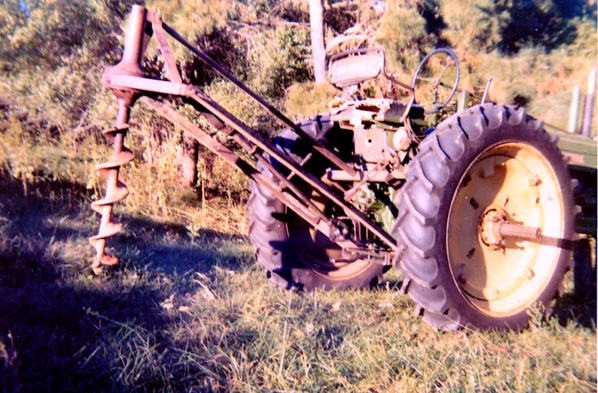
There the big bad home made hole digger is raised out of a freshly dug hole, with red clay still clinging onto the auger. The B Model John Deere’s seat looks a little ragged by now. Photo taken in 1970.
There was only one small detail, when the digger had dug the hole and was being raised up out of the fresh earth, it seemed like the hole filled with more dirt than had been there in the beginning. Then my job began and consisted of taking hand operated hole diggers and “cleaning” out each hole. After the hole was clean of loose soil, I immediately filled the hole with a locust wood fence post. These posts made from Black Locust trees and were hard as concrete. Nails and fence staples were hard to start and drive up in the wood made of steel. Anyway, I would line up the fence post with the now tightly placed sting that showed where the fence line was to be correctly place. I would then start kicking in the dirt with my boots and after a few kicks I would then start to ever so gently but correctly tamp the dirt tight around the post. This maneuver was repeated over and over until the post was just like it had been set in concrete. Post after post was planted and tamped in line to the string. Once done the fence line full of posts was straight and true ready and next was the unrolling of the barb wire. Barb wire comes in rolls that dad and I would unroll by putting the roll on a steal rod and walking the wire off down the fence line. The roll would turn over and over on the steal bar and sometimes would wander over to either my side or dad’s side and try to tear our gloves off our hands. We were always attempting to keep the bar level and avoid the tearing thorns that barb wire are infamous. On some fence lines the fence row was out in the open and did not go through the woods, so we could place the roll of barb wire and the steel bar and place this assembly onto the bottom tow points of the three point hitch on the Model B John Deere. This made for a much safer and easier method and increased our time to finish greatly.
NOTE: The steal bar was actually one of the inner axles from the 32 ford rear end. When dad took the rear end apart, he savaged the actual steal axels from the housing and had them turned into proud bars with one end dedicated to receive blows from a sledged hammer and the other end with a forged wedge shaped tip that would allow it to act as a pry bar or even a legal weapon to cut through roots that the post hole digger had discovered but not given fair treatment. I had to set the record straight about my dad, he was always able to make things out of junk, but as the same time he kept everything and that keeping trait was handed down to me. To this day, I have the hardest time throwing away an empty Amazon box.
Once the barb wire strands were all laid out and dad insisted on five strands, we secured one end of a strand to the starting point and went to what was called the pull point. Sometimes this was the other end of the strand and sometimes it was much closer to the beginning point. The reason was very clear if you had been out on the fence line, topology. If the fence line went over land that had a hill or valley along it, then if you pull the strand from the distant end, you could not bring the wire down or up to secure it to the posts in between. Oh and one more part of the puzzle was the cross brace pull posts.
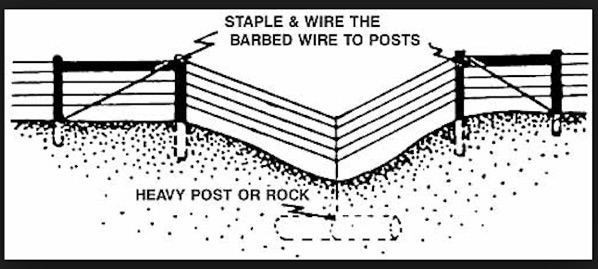
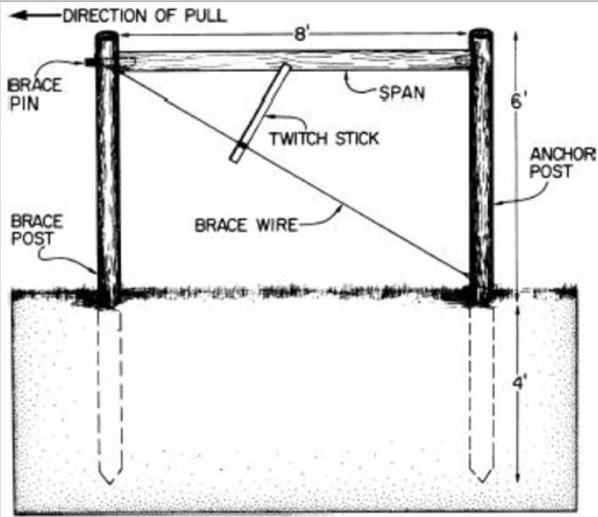
A pull post were two posts that were set closer together than normally. These two posts had one more fence post affixed to them. This post was place a few inches down from the top line of the two posts and held there with nails. The job of this post was to stop the two pull posts from giving way and becoming closer together at the top when the next component was added. The next component was stiff and hard to bend wire, that was affixed to the two pull posts forming a diagonal line. We knew how long the wire had to be and uncoiled it from it’s roll onto the ground. We then nailed staples at the top and near the ground level of the two pull posts. We then ran the wire thru these staples so that the wire made two complete trips from the top of one pull post to the bottom of the next pull post. It was then tied off by twisting the two ends of the wire together with some fence pliers. Once the wire was in placed and secure, we found and cut a strong beach wood branch that was about 2 inches in diameter. This branch was then placed in between the now four strands of wire in one of the legs of the cross and we then began to tighten that leg of the cross by turning the the branch over and over.
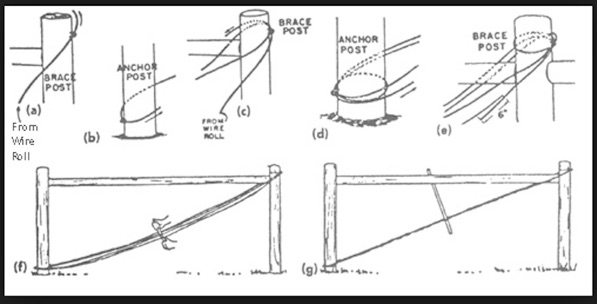
This put an extreme amount of tension onto the wire and created a very strong assembly. These pull posts had to be built to transfer the pulling force correctly. Below is an illustration of a pull post at one end of a fence line. Of course if you walked to the end of this fence line, then you would have seen a mirror image of this pull post cause the direction of pull was just the opposite. On very long spans or you had hills and valleys in between, you had to build a double version of the pull post. You then would pull each strand to this double version tie it down and then pull from this point on to the next pull post. Lots of fun building a fence the correct way.
So after I got out of high school and was in college and was taking newtonian physics, I had no trouble understanding force and other newtonian concepts. Of course being around my dad, some of his engineering mind must have been transferred also. He was finishing up his junior year at Georgia Tech when the depression hit. He was forced to stop school due to lack of money in his house hold. He went to work in the CCC and was assigned to be a chain puller on a survey crew. Dad was in the Electrical Engineering Department at Tech and I always thought it strange that his first job was surveying. His explanation was simple, I did not have a choice.
One more thing about the fences was that in the coldest days of winter; you had to go and walk the same fence line you had just built six months prior and look for staples that had decided the wire tension was too much to stay put. Yes, the lower temperature had made the wire get tighter and tighter due to its contraction of its length. So by February, there were several staples that had popped right out of the solid black locust posts. The wire strands had become so tight from the cold, you could almost play them like a banjo.
I need to add one more vital piece to the fence puzzle. This vital piece had two components. One was called a come along and the other was a block and tackle. The come along was a little gadget that would grip a strand of barb wire and not let go. It had a loop on it that we attached to the block and tackle hook. The other end of the block and tackle was chained to the Model B John Deere. One could start pulling on the rope puller and magically the rope went thru all the pulleys and started making the barb wire tighter and tighter. This was always the most dangerous part of fence building and on several occasions we sustained some nasty barb wire injuries to our hands and arms due to the tensioned wire jumping onto our arms and hands. The jumping wire was always our fault and was due to negligence on our part always. I still have the come along and the block and tackle and here is a photo to prove it here:
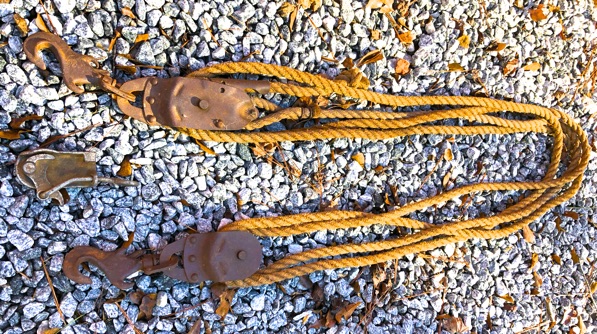
These two items stretched many strands of barb wire in the day. Whoever named the come along was very original. The tool grabs the wire and the next thing you know the strand of wire is coming along right with the come along.
I remember one summer of work that was the most fun for me. Dad had decided to completely renovate the water line coming from our well to the house and add water spigots at key points around the yard. Dad hired John Henry Rogers and Slim from Norcross to do the ditch digging. They came faithfully everyday at 7am and left drenched in sweat heavy clothes at 4pm. They dug a ditch line straight as an arrow and twenty inches deep. The trench started at our well and went about fifty feet to a tee point. If you went left at the tee point, the line went about eighty feet to another tee point. If you went right at that tee, you would dead end into the spigot for watering the cows in the back pasture. If you had continued on the other leg of the tee point you would dead end into the other spigot for watering the cows in the front pasture. I never discovered where dad got the two bath tubs at these two watering locations but I remember how nice and white they were and how the cows enjoyed the water.
Back at the fist tee point, if you had made a right turn there you would have gone about sixty feet to another tee point where if you had turned right you would have dead ended into the spigot for washing cars. If you had continue the other leg of the tee, you would have gone several hundred feet to the entrance of the water line into our cellar crawl space. Looking back I now always wondered why dad did not renovate and eliminate the exposed water line in that crawl space. If you remember it was the one that would freeze and stop all water to our house on cold winter’s nights. I do remember years later he bought a gadget that stopped the renegade water pipe from freezing. It was a long coated red wired that you would wrap around the suspect pipe. It had a plug on one end that you would connect to an extension cord and the gadget would warm up due to its internal resistance and keep the pipe nice and warm. I was happy dad did not have to get the blow torch out again in the freezing cold night or morning air. It was like we had moved into the next century…
So John Henry and Slim dug for two weeks the deep and long and straight trenches for the new water lines. Then dad and I went to work. He had gotten these long rolls of one inch black plastic pipe and when we first started to unroll them they protested by not wanting to stay strait, however the July sun soon changed the mind of each long section of black plastic pipe and it soon be putty in our hands. We placed the pipe in the trench and dad attached these fittings to it allowing the black plastic pipe to go where he wanted it to go and do what he wanted it to do. All during the ditch digging and pipe laying, I had a side line hobby of setting off m-80 fire crackers. These had enough power in them to blow a dog food can into the air for more than 50 feet. I experimented with different cans to launch and found the twin pet dog food can was the best one. It got the most “air” and went the highest and was mostly reusable as the closed end remained intact for several launches. I was highly disappointed when the Georgia Legislature passed a law banning the m-80 and other fun toys from purchase in Georgia. Evidently some stupid kids were blowing their fingers off their hands and hurting themselves and due to their accidents, I had to go with out my favorite toys. Even the roman candles were banned. These were the most fun as you could light the fuse and in a few seconds they would fire off small charges that absolutely terrified our cats. I never was able to hit a cat with the fire laden roman candle charge, but if it had made contact I am sure the cat would have gotten a new hair do.
Our well was the original well that had been dug for our dwelling. He was 78 feet deep and was huge in diameter. It had a huge concrete lid or top covering it up. On occasion we had to pull the pump and attend to the foot valve at the bottom of the black plastic pipe. Dad would take one of the 1932 Ford axel pry bars and using its leverage he would pry the top off the well. There exposed to the sun was a hole about six feet in diameter and if you caught the light just right you could see the shimmering water at the bottom. The pulling of the pump did not happen frequently but when it did it created quite a scene. One of us would pick up the heavy pump and water line assembly below it and start walking away from the well. The other one would have to stand at the well and assist by pulling up on the two black plastic pipes that were full of water. This was quite heavy and we as a team had to stop several times and get our breath during the marathon of pulling the pump. Once the pump and it’s seventy feet of black plastic line was out of the well and laying on the grass near the well, dad went to work replacing the stuck or leaky foot valve. Sometimes dad had to do extreme surgery and replace the jet and foot valve assembly. Somehow he always figured out what was causing the problem and fixed it. I found this photo of exactly what was at the end of pump’s well piping going down into the well. It even resembles my left hand and the weeds we had growing in our yard.
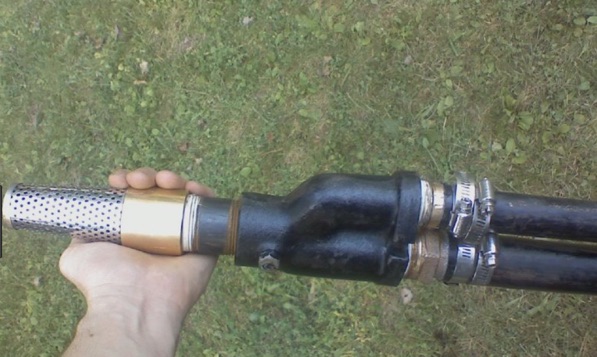
The hand is holding the foot valve while use to its right is the “jet assembly”. A jet styled pump actually used a downward push of water in one line to push or jet the water out of the well. Inside the jet assembly was something called a venturi tube. It was magic and allowed the water coming down into the jet assembly to create a high pressure gradient and push much more water up the pipe than was coming down.
The end of my work saga for now.