
Memories in writing from Larry Garrard
Taking time to fish
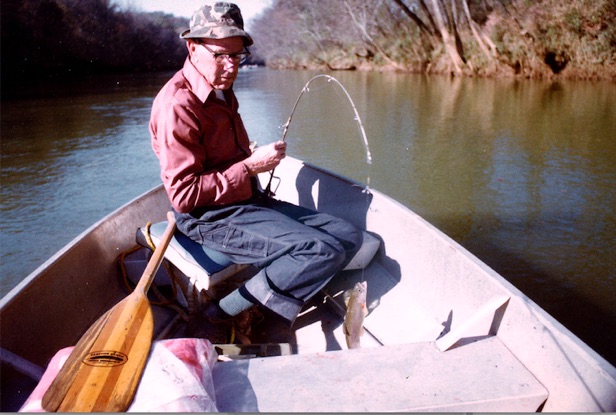
Growing up on Holcomb Bridge Road seemed to be boring at the time, but now when I recall the past, I had some fun times. Seems like my dad and I could find time to wet a hook every weekend. Dad worked at Lockheed in Marietta during the week. But during trout season from April to October; he like to put the old john boat in and motor up and down the river. Way before I was old enough to fish with dad, he had a boat tied to a tree down on our lower river bottom pasture. As far as I can recall, it looked like a hand made wooden boat. My recollection is tainted by the fact that one spring, when the river flooded, the boat’s mooring chain could not contend with the weight of a sunken wooden boat and gave way. Since this happened early in my life, I can’t remember how dad took it, but years later he make a point to show me the nail he place in a walnut tree showing the highest water level he had ever witness. This nail was about 15 feet up in the tree. I don’t know when this flood occurred but it might be the one that demolished Old Jones Bridge. In one of the spring floods, Dad told me that he had to rescue one baby calf that had been caught in the flood. Evidently the calf got to close to the new river bank ( More than 200 feet from it’s normal place) and had slipped into the fast moving water. Somehow it got caught up in the top of a sturdy pine tree and was able to hang on. It was not happy and was making a valiant effort to get’s it mama to come rescue it. However dad could hear it’s unmistakable pleas for help from the back yard and was able to rescue it using the old wooden john boat.
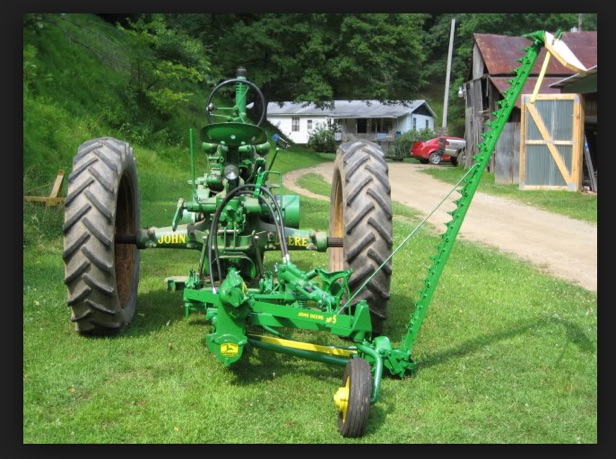
Now I do remember vividly my many river fishing trips with dad. We headed out in all aluminum john boat. We would haul it on the hand made trailer to the launching point. The trailer was cool. It was a wooden frame place on the front axle from an old car. Dad had figured out a way to stabilize the axel’s steering mechanism and with the leaf springs, this trailer could carry quite a load. Later on I found out just how much the trailer could haul. Dad decided to sub soil plow our front pasture hillside. “Oh it will open the ground to breathe and we will get a better crop of hay” was what resonated in my head. Well that plow would sink down about 15 to 20 inches in the soil and yet did not turn the ground over and make a mess. It was like a knife cutting through the ground and opening up a slit that was kind of amazing. However, it also brought up rocks on occasion and left them shining in the sun. These rocks would have been a death knell to our hay mower. Our hay mower was a John Deere number 5 cycle bar mower.
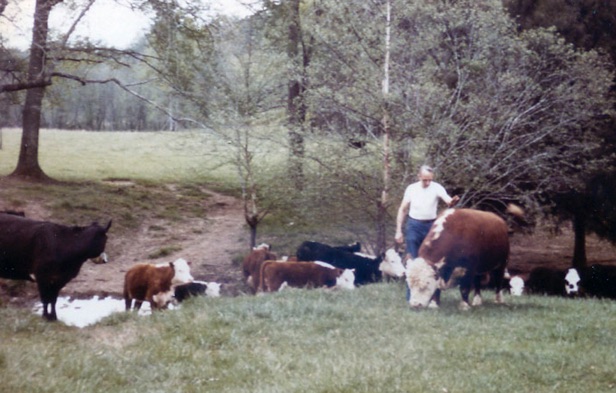
I know you are wondering if I am ever going to get back to fishing, but when I start recalling memories, sometime one thing leads to another that is just a much fun to languish in before getting back to the start again. So the rocks, so many rocks; and only dad and I were there to remove them, one by one. We hooked the hand made trailer to the tractor every day for weeks. Dad would get home from Lockheed about 4:30 pm and by 5:15 we were picking up the rocks and onto the trailer they would go. Now dad was kind of an engineer and wanted to make the fewest trips with the trailer to where we would empty it. So we would load the trailer until the leaf springs would change shape from their slightly upward curve to a perfectly flat shape. Then off we would go back and down he hillside to where the creek was on our land. This creek would deter one from crossing it to get to the back of our land, due to the mud and soft soil that it ran over. Load after load of rocks were taken to this spot and one by one each rock was thrown into the creek and after a few month, a nice rock laden creek crossing point was in place. We even tested it by pulling a load of rocks across it. We noticed some sinking of the rock crossing but no problem as we had more rocks to fill in the ruts. This next photo shows the creek crossing a decade later. That is dad checking on his herd and making sure “buck” is still friends…
Now let’s go fishing.
One sunny day as we were launching the boat down by the Dekalb County Water Intake, which we had done a million times before, disaster struck. The launching location was horrible. It had huge bolders that you had to walk over and where the high water would deposit some kind river mud concoction that was as slick as owl… Anyway, as I said we had done this many a time before and had a system of who does what job. We would both carry the boat down with very little inside it. We needed it to be light in weight and agile. We then would hook the anchor rope around one of the bolders and head back up to the trailer to bring our tackle and the green machine back to the waiting boat. The green machine was a 1957 Elgin, two cycle, two cylinder outboard motor. It was heavy, but we used it and knew how to maintain it. So my job was to hold the boat steady as dad walked the center beam of the boat carrying the heavy Elgin.
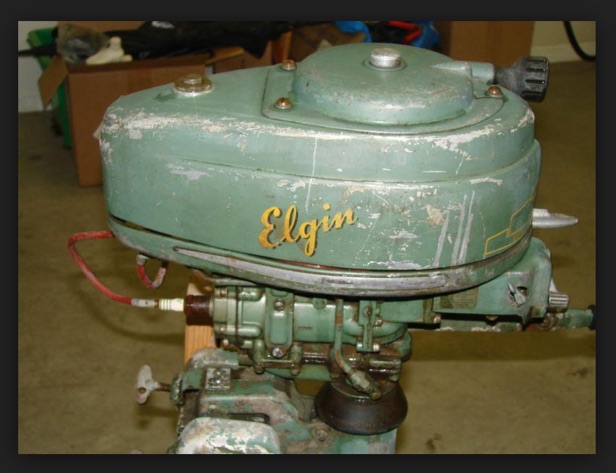
Dad would swing the Elgin out over the water and I would counter his move by holding the boat from doing the opposite of what he was doing. Over and over we had done this and never a problem. Well, then our time came and we accidentally lost our recipe for this maneuver and into the water went dad and the Elgin. I saw it happen and still don’t know how or why it happened. Dad moved fast and put the dripping Elgin back into the boat before you could blink your eyes. We both were in despair as the Elgin was not willing to start after it’s baptism. Dad said let’s go fix it. So off we went back up to the tractor shed where dad took the Elgin apart. Off came the gas tank and under there was a gadget called a magneto. This magneto was the magic part that made the spark that was sent to the spark plugs. We had determined the Elgin was without spark. So dad took the magneto and baked it in the oven at 250 degrees for about an hour. As it was baking, we emptied the gas tank and cleaned out the carburetor and other vital parts of the Elgin.
Oh, I just wanted to go back to the flooding river story before the Elgin comes out of the oven. I can remember many spring time floods. The river would leave it’s banks and wander all over our bottom fields. It ran red with run off from upstream erosion and made our bottom fields look like red lakes. Later in my life the river stopped flooding in the spring because it had been dammed up creating Lake Sydney Lanier. This flooding made our river bottoms very fertile and later in my lifetime were the source of many loads of fescue hay and more fun times that I will report on in a future memory. There was another big change in the river’s personality. She changed from a warm water river with a complement of catfish, yellow perch, bream and small mouth bass to a cold water river that could support rainbow trout. The native fish continued to live and reproduce in the river, but the valiant DNR decide to purge the native fish from the river. I witnessed this purging one day. The DNR boat was equipped with an electric shock mechanism. The DNR ranger told me that they would anchor, shock the fish, they would be stunned for a short time and float up to the top due to their air bladders not having any muscles working to keep them in a normal position in the river. The rangers would net the poor natives and into boat they would go. Evidently the native population had been dwindling and so after a few weeks of shocking the natives were gone. After that we always brought back trout to the our kitchen where we feasted on them.
Now let’s get the Elgin and go back to the river.
We put the Elgin back together and placed it into a barrel with water and with one pull, she fired up and ran like a jewel. It was about 3 o’clock and we headed for the river. Off we went this time without a hitch and as I remember; we stopped at our favorite fishing hole we had knick named “the dump”. It was a location that the our neighbors living on the Neely Farm would take their trash and through into the river. Over the years the fish learned that this place was like a cafeteria for them. Sometime we would anchor and enjoy catching our limit of trout without even having to go any where else.